
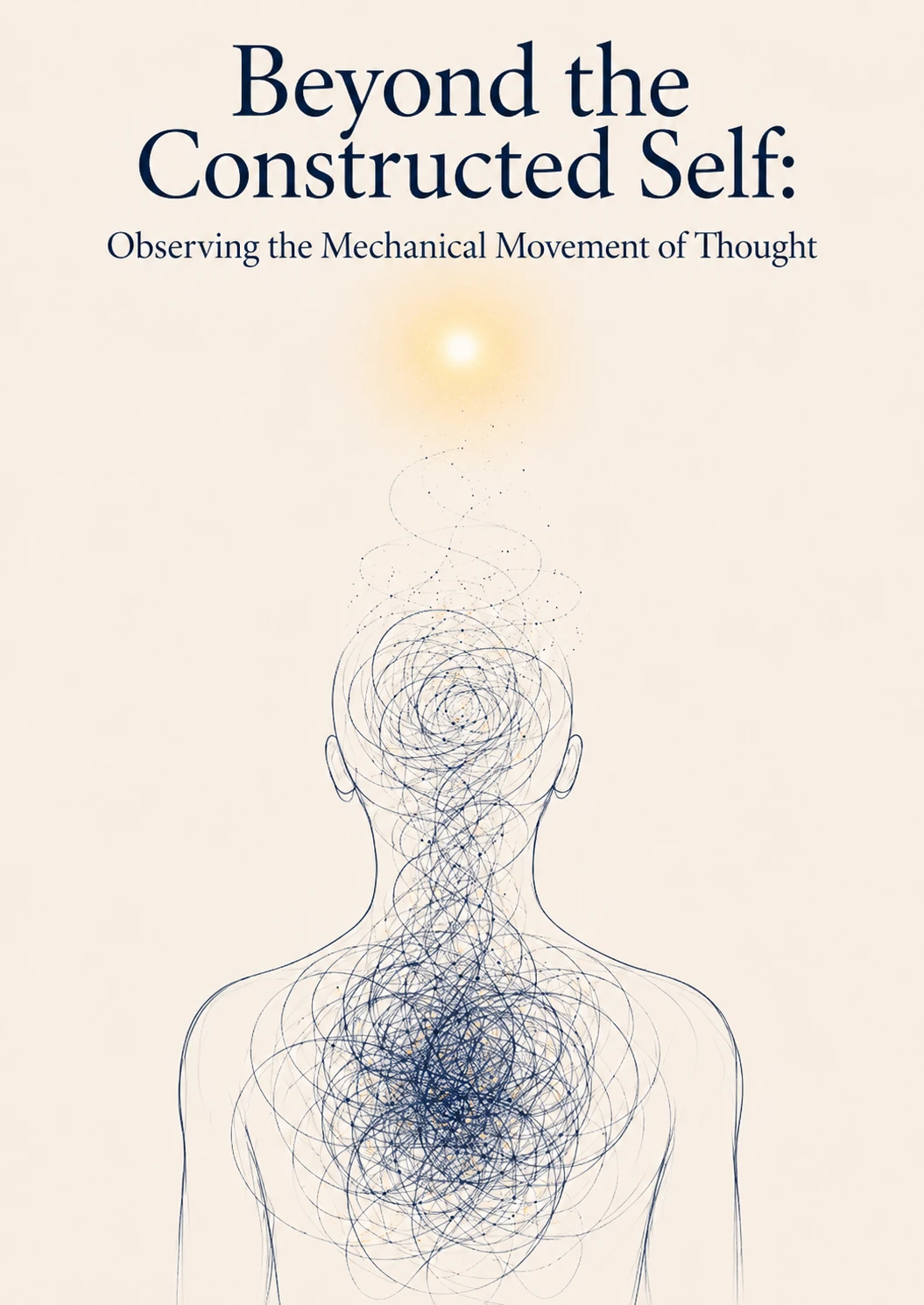
Summary
This essay explores how thought mechanically creates memory, emotion, identity, and the sense of a separate self. By observing thought without becoming absorbed in its movement, consciousness can understand how the self-concept is formed, loosen its identification with it, and rediscover a more natural and living state of being.
Thought as a Mechanical Phenomenon
Thought is a mechanical phenomenon, as consciousness sees it.
Just as the eyes can see my hands working and moving, consciousness can observe thought working and moving through memory, emotions, intentions, and other mental contents.
Thought plays an important role in the three states of life: waking, dreaming, and sleep.
While awake and continuously interacting with the environment, thought moves and expands through responses and reactions, as when we are engaged in a serious conversation. However, it can also continue independently according to its own internal stimuli.
Through emotional feedback, the mind becomes internally involved and enters a condition close to the dream state. In this movement, the world of emotions plays a significant role, along with deeply impressed desires.
The Movement of Thought in Dreams and Sleep
In dreams, the mind continues the same mechanical activity of thought.
One thought after another bubbles up on the surface of the mind. Some thoughts are registered, while others pass without being noticed.
Sleep may therefore be understood as an alternate state of thinking activity, in which gaps appear between movements of thought.
Surprisingly, this mechanical activity has continued throughout my life.
Everything I have learned about the world, from the world, and about myself—including the meaning I have given to this self—has been shaped through thought and its attachments. In general, everything becomes associated with this movement.
Observing the whole movement brings an insight that exists outside thought.
It is important to see this not merely as an intellectual idea, but in a completely experiential way.
Observing Thought Without Following It
This understanding does not arise through thought or through thinking alone.
Thinking is the formation of a network of thoughts based on mental objects—memories, emotions, stimuli, responses, feedback, triggers, the ego, and the self-concept.
All these are parts of the thinking process.
However, observing the entire movement without moving along with it brings a different kind of insight into human consciousness.
This insight has the capacity to transform the way we see ourselves. We begin to perceive ourselves differently, and a kind of detached attachment enters our experience.
A more real meaning begins to emerge.
I use the word real for a reason. While living in this world, for example, we hear and use the word love very often. Yet I may never have truly been in love or directly experienced the emotional movement of love.
Conceptual Knowledge Versus Direct Experience
Still, my mind gathers so much information about the word love from the world that it forms a meaning around it, and I begin using the word for myself.
It may then become a meaningless word—or its meaning may be limited to something I have learned, while my actual being does not know it directly.
The mind imitates concepts because, from the beginning of its learning, it has possessed the capacity to attach itself, cling to ideas, become conditioned, and construct a self-concept.
As a human being, I know the word love and use it according to different situations—at home, among children, in society, and even in expressions such as personal love and universal love.
Yet even with so much knowledge, I may remain without truly knowing love.
Insight and Detached Observation
Therefore, this knowledge is not completely real, even though the mind has accepted it as part of reality.
Once I begin to observe the mechanical process of thinking and its movement, insight touches it.
This insight creates a kind of detached attachment. From a centred place, the movement of thought can be seen just as the eyes observe objects moving around them.
This is a very different form of learning and experience.
It is like standing silently at an airport and watching people, aeroplanes, cars, trucks, and lights moving around with still eyes.
In the same way, the mind can be observed through the movement of memories, emotions, ego, self-formation, and their continuing patterns. A thought begins with one thread or another, sustains itself for some time, and eventually disappears.
The Formation of the Unique Self-Concept
This activity continues with occasional gaps, yet it keeps moving and changing.
It fills the mind with a unique self-concept and a particular point of view.
Some people carry more pride than others. Some are more emotional, while others are more inclined toward thinking.
Different dimensions of the thinking process become impressed upon different people in varying degrees. Through these impressions, a unique self-concept is formed in each person.
Understanding this process of self-formation brings another insight.
It begins to dissolve the pseudo-self and reveals the mechanical nature of the mind.
For example, when a gentle breeze touches the skin, it creates a pleasant experience. A moment later, the breeze stops and the experience disappears. The body recognizes this as a temporary and mechanical experience.
Seeing the Emptiness of the Constructed Self
Similarly, the mind thinks through the activity of its various faculties. Through them, the self is constructed, sustained, and eventually dissolved.
Consciousness has the capacity to understand this.
In ordinary life, however, we usually do not recognize this process. Instead, we create self-images and concepts.
As though we possess complete control over the contents of consciousness, we convince ourselves that the doer is “me” or “myself.”
Once consciousness clearly sees the formation, continuation, and disappearance of the self-concept, it recognizes that this constructed self is empty of any permanent identity.
This realization—or direct experience of emptiness—is itself an insight.
It deeply influences the structure of the mind and its understanding of the self.
It is worth knowing the difference between the living self and the self-concept created by thought.
Living Without a Fixed Self-Concept
A being who knows or realizes the self without forming a fixed self-concept is insightful and alive.
Such a being truly lives and truly dies.
With all my being, I respect this natural state of beingness.