
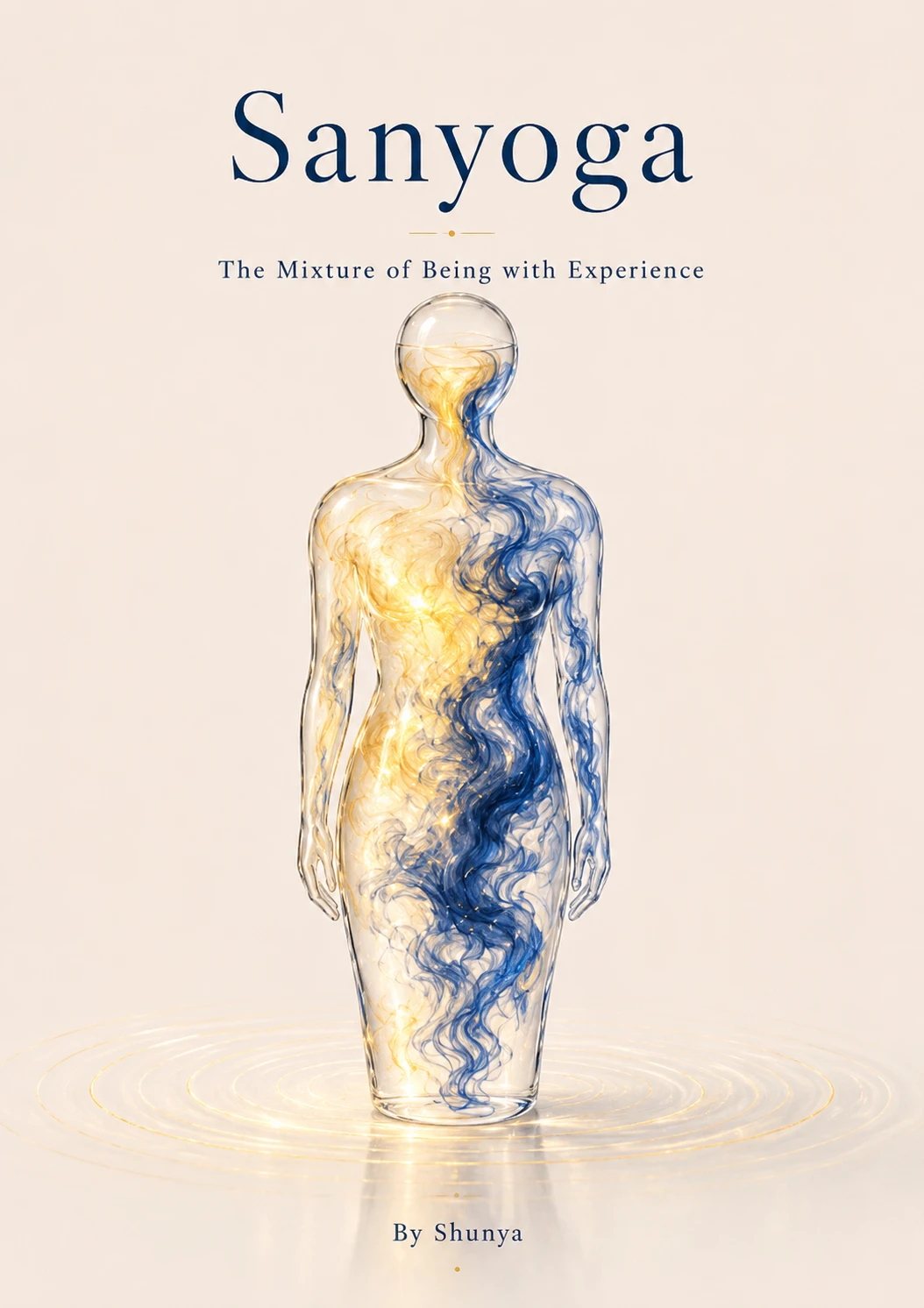
Patanjali names this precisely. In the Yoga Sutras, sanyoga — the conflation of drashta (the seer, pure awareness) with drishya (the seen, the field of mind and matter) — is identified as the root cause of duhkha, of all suffering (Yoga Sutra 2.17). What your mind does daily, then, is not incidental. It is the very mechanism the sutras describe.
Mind has a tendency to mix the quality of awareness — the nature of the knower, the sheer potential of knowing — with the object, with mind-stuff (citta) built from memory and from sensations arising through contact with the world. This is sanyoga in motion.
This mixture triggers the conditioning of the mind. Patanjali calls this conditioning avidya — not simple ignorance, but a positive misperception: taking the impermanent for permanent, the impure for pure, the painful for pleasant, the not-self for Self (Yoga Sutra 2.5). Avidya is the soil; sanyoga is what grows from it, in turn shaping the citta further.
Continuous mixing makes it a habit. Each repetition leaves behind a samskara — an imprint — and the imprints accumulate into vasanas, tendencies that run on their own momentum. This is why the same mixture keeps producing the same pleasurable outcomes: a sense of pride, a sense of ownership. And these pleasurable outcomes, along with the desire for them, keep directing the tendency to mix — pulling awareness, which in its true nature is pure and untouched, back into identification with mind-stuff built from nothing more than circumstance.
Hence there is bondage — bandha — for the self, for this potential of awareness that was never meant to be bound.
Mind-stuff takes on color the way the three gunas — sattva, rajas, tamas — color everything they touch: good or bad, violent or nonviolent, atheist or God-believer, religious or agnostic. These are not qualities of the Self. They are qualities of the instrument mistaken for the Self.
In the end, mind-stuff performs the same single action regardless of which color it wears: it coats pure consciousness, which is itself a very refined quality of beingness — untouched, untouchable, but obscured.
When this mixture runs its full course, it produces what feels like a self. Patanjali gives this exact appearance a name: asmita — the near-total identification of the power of seeing (purusha) with the very instrument used for seeing (buddhi, the intellect), until the two feel like one thing (Yoga Sutra 2.6). This is what a human being takes to be “I,” to be ego. It is not false in the sense of being nothing — it is false in the sense of being a mixture mistaken for a unity.
This so-called “I” is nothing more than a bundle of experiences — arising from contact with the world, or from the internal churn of mind-stuff. It has no independent existence of its own; it is sanyoga, wearing the mask of a self.
The moment pure consciousness receives this understanding — not as an idea, but as viveka-khyati, discriminative discernment, the clear seeing that seer and seen were never actually one (Yoga Sutra 2.25–2.26) — the intensity of the ego dissolves. It does not vanish from function; it becomes merely operative. It still signs the checks, still answers to a name. But it no longer claims to be the one living the life.
Awareness becomes established in pure being — what Patanjali calls resting swarupe, in one’s own true nature (Yoga Sutra 1.3) — rather than in the activity of vrittis, the modifications and fluctuations of mind, whether physical or mental.
All activity, from this ground, becomes a matter of sustenance and utility. Nothing more urgent, nothing more identity-bearing than that.
All beings should understand this, so that action is no longer performed through a pseudo-ego claiming ownership of it, but simply as a surface phenomenon — movement on the skin of life, not at its root.
Beingness itself carries this same potential of life in plants, in animals, and in humans, without distinction. Prakriti, the field of the seen, is one field throughout; it does not create hierarchies of worth, only differences of manifestation.
Humans alone have shown the capacity to know this potential in its natural, unmixed form — to turn awareness back on itself. This is the unique opening the human instrument offers.
Not all humans use it, however. Most see only the manifested being within themselves — the sanyoga, the mixture, the pseudo-self — and mistake it for the whole of who they are. This manifestation, this coloring, is caused entirely by sanyoga.
Blessed are those beings who become aware of their own natural, unmanifested life — the purusha untouched by prakriti, resting in itself. Blessed are those who strive for this. And blessed, above all, are those who attain it — who reach kaivalya, the aloneness of pure seeing, free of the mixture that was never truly its own.