
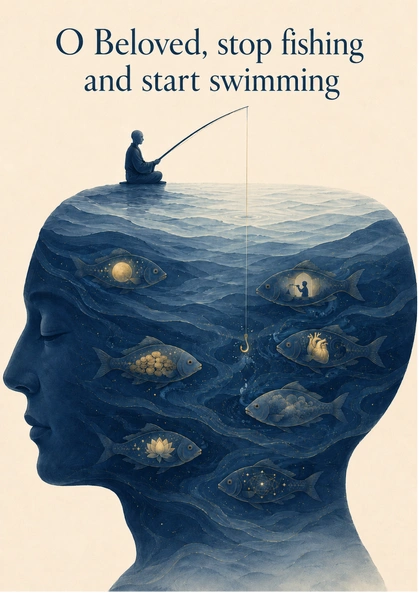
The Fisherman at the Shore
Today, I sat quietly beside the ocean like a fisherman, waiting for the fish to come.
The fish are the objects of the mind—thoughts, memories, desires, emotions, achievements, beliefs, and images of who I think I am. My mind has spent its whole life catching them, naming them, and holding them close.
In this constant activity of fishing, I have overlooked the vast ocean before me.
I have become an old and skilful fisherman. I have learned how to recognize every movement beneath the surface. I know how to catch subtle thoughts, refined ideas, beautiful experiences, and even spiritual concepts.
Whenever I catch something, I call it mine.
My knowledge.
My success.
My suffering.
My insight.
My identity.
Each catch strengthens the fisherman, yet none reveals the ocean.
I have celebrated every fish I caught, but it rarely occurred to me to put down the net, leave the shore, and touch the water itself.
Then, in a quiet moment, a simple question arose:
What remains when there is nothing left to catch?
For a moment, the fisherman became still.
The ocean did not disappear.
The emptiness of my hands was not a loss. It was the first opening through which the vastness could be felt.
The ocean is consciousness—open, immeasurable, and without possession. Thoughts arise within it like fish appearing beneath the surface. They move, shimmer, and disappear, but the ocean is not limited by any one of them.
Perhaps I do not need another fish.
Perhaps I need to discover the spaciousness in which all fish come and go.
Entering the Ocean
I hold the fish, but the ocean holds me.
The fish do not prevent freedom. My habit of grasping them does.
The mind fears empty hands because it has learned to measure life through possession. It believes that without thoughts, memories, roles, and conclusions, there will be nothing left.
Yet emptiness is not nothingness.
Emptiness is the absence of confinement.
It is the open water in which every movement is free to arise and dissolve. It is the silence that does not resist sound. It is the space that allows every form to appear without becoming trapped in any form.
When I enter the ocean, I do not destroy the fish. I stop imprisoning them.
Thoughts continue to move. Emotions still rise. Memories return. Experiences come and pass. But I no longer need to turn each one into a permanent identity.
The fisherman says:
This thought is me.
This pain belongs to me.
This achievement defines me.
This belief must remain with me.
The swimmer allows each movement to pass through the vastness.
In swimming, there is no shore to defend and no net to protect. There is only participation in the living movement of the ocean.
The more deeply I enter, the less separate I feel.
The boundaries created by thought begin to soften. The one who was watching the ocean from the outside discovers that there was never truly an outside.
The fisherman, the fish, and the ocean have always appeared within the same vast consciousness.
Embracing Emptiness
To embrace emptiness is not to reject life.
It is to stop filling every open space with thought.
Usually, when silence appears, the mind quickly casts another net. It searches for an explanation, an image, a conclusion, or a new experience. It fears the unoccupied space because the self cannot easily survive there.
The constructed self depends upon accumulation.
It gathers memories and says, “This is my past.”
It gathers desires and says, “This is my future.”
It gathers experiences and says, “This is who I am.”
Emptiness gently loosens these collections.
It does not erase memory or prevent action. It simply reveals that no memory, thought, or experience contains the whole of being.
In emptiness, nothing must be held in order for life to continue.
Breath enters and leaves.
Waves rise and fall.
Thought appears and disappears.
Life moves without asking the fisherman to control it.
This emptiness is not cold or lifeless. It is full without being occupied. It contains every possibility without clinging to any outcome.
When I stop resisting it, emptiness becomes intimacy with life itself.
There is no need to stand apart and observe the ocean as an object. There is no need to become someone special through spiritual knowledge. There is only the direct experience of being—clear, unburdened, and open.
The End of Fishing
O beloved, the fish will continue to swim.
Let them.
Some will be beautiful. Some will frighten you. Some will remind you of the past, while others will promise a better future.
See them, but do not build your home around them.
The ocean cannot be known by collecting its fish.
Consciousness cannot be understood by accumulating thoughts about consciousness.
Truth cannot be possessed by the one who is always trying to catch it.
Put down the net.
Allow your hands to become empty.
Let the emptiness initially feel uncertain. Stay with it gently. Beneath the fear of having nothing, you may discover the freedom of needing nothing to complete you.
Then the fisherman can rest.
Not because life has ended, but because separation has begun to dissolve.
You no longer wait at the edge of consciousness for a meaningful experience to arrive. You enter the vastness from which every experience arises.
You stop asking the ocean to give you something.
You become available to the ocean.
O beloved, stop fishing.
Let the fish come and go.
Enter the water.
Embrace the emptiness.
And begin to swim.